Why Organizations Are Outsourcing Their Investment Operations

What Is an OCIO?
An Outsourced Chief Investment Officer, or “OCIO,” is a service provider that performs investment management-related functions on behalf of its clients. This can include overall investment strategy implementation, asset allocation, investment manager selection and operations management.
In a traditional investment model that does not utilize an OCIO, organizations are responsible for these investment functions, often performing them “in house.” By contrast, in an OCIO model,
a third-party provider takes on many of the routine investment decision-making responsibilities typically handled by their investment committees.
Organizations often choose the OCIO model to help cut costs, improve their investment program’s oversight and governance, benefit from their provider’s scale, and free up capacity to be redeployed in other areas of their business.
Interest in OCIO Services Is Growing
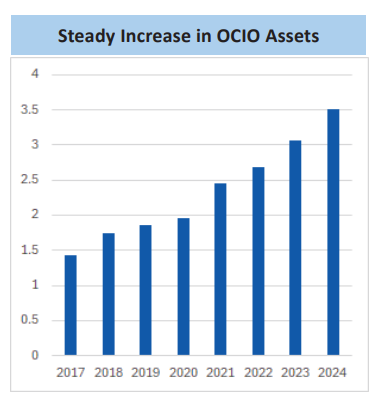
According to Pensions & Investments’ data, worldwide assets managed by OCIO providers grew 14.6% to over
$3.5 trillion, in the 12-month period ending March 31, 2025.1 There was a similar surge last year following the end of the rate hiking cycle.
The OCIO model continues to gain in popularity as more investment committees come to understand that having an investment partner that operates in a fiduciary capacity can increase the effectiveness of their investment programs.
In addition, many organizations-especially those in the faith-based, not-for-profit world-do not have the resources to dedicate to making complex investment decisions. When these not-for-profit organizations delegate some key responsibilities to an OCIO partner, they gain more time to focus on their missions.
Organizations must select the OCIO solution that is right for them. When considering the appropriate option, it helps to define specific investment goals and think about what functions will benefit most from outsourcing. Organizations may also consider whether their own mission aligns with that of the OCIO.
Which Type of OCIO Provider Is Right for You?
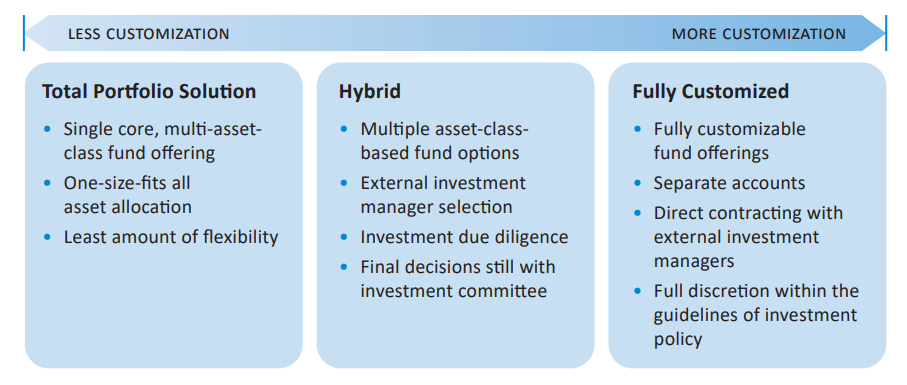
Once an organization chooses to adopt the OCIO model, they must decide what “level” of OCIO services will address their investment needs. OCIOs exist in many forms, ranging from global banks and consultants to more boutique, niche providers. Each OCIO offers different options in terms of customization and breadth of service.
There are three main OCIO categories: Total Portfolio Solution, Fully Customized and Hybrid.
Organizations must select the OCIO solution that is right for them. When considering the appropriate option, it helps to define specific investment goals and think about what functions will benefit most from outsourcing. Organizations may also consider whether their own mission aligns with that of the OCIO.
There is a growing market of OCIO search consultants that help organizations with the OCIO selection process. Search consultants perform due diligence and evaluate each OCIO candidate’s capabilities and service models, providing more context for an eventual hire decision. Consultants also get a close look at an organization’s mission, so their perspective on specific OCIO services and mission alignment may be especially valuable.