Asset Allocation Factors for Mission-Focused Investors

Determining your optimal asset allocation is a key component of the investment process. This holds true for all investors, from an individual preparing for retirement, to a large corporation seeking to fund a multi-billion-dollar pension portfolio.
Certain investors have unique organizational factors to consider as well. For example, many not-for-profit, mission-focused investors are faced with the challenge of maintaining a healthy portfolio of investments that can support their missions in perpetuity—all while responsibly managing costs, resources and employee capacity.
Also read: Spending Policies for Endowments and Foundations
What Is Asset Allocation?
Asset allocation is a strategy that seeks to find the ideal balance of risk and reward in a portfolio by adjusting how an investor’s assets are apportioned, or allocated, across various asset classes.1 We know that individual asset classes—be it equities, fixed income, alternatives, cash or another investable asset—respond differently to various market conditions and economic events. Over the long-term, asset classes tend to deliver varying amounts of risk and return.
It follows that an investor would want to allocate their assets in a way that best supports their long-term goals. Whereas an individual nearing retirement may desire to be more heavily allocated to lower risk, fixed income investments, an individual at the beginning of their career may be willing to take on higher-risk investments through the equity markets in hopes of accumulating stronger returns over time. Likewise, an organization needing to make defined benefit pension payments three decades from now will likely have a different asset allocation than one aiming to fund a mission-based spending initiative within the next year.
Key Considerations for Mission-Focused Organizations
The first step in developing asset allocations for mission-focused investors is to define each organization’s investment goals. These investment goals should align with the established mission of the organization.
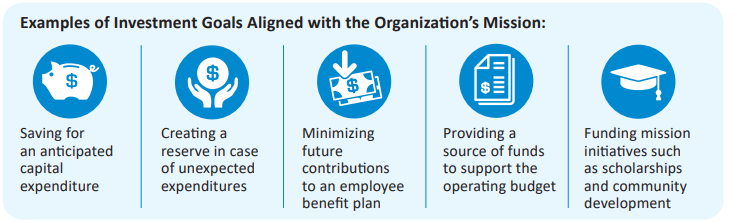
It is also vital for an organization to determine the unique time horizon of its investment. In other words, within what timeframe do the goals need to be achieved? When will the organization need the money to fund its goals? Several common investor time horizons are noted below, along with the amount of risk/return typically associated with each.
Types of Time Horizons with Their Typical Risk/Return Profiles
| Short-Term Horizon (<12 Months) | Requires short-term large cash flows and anticipates limited time to recover from potential declines in asset values |
| Intermediate-Term Horizon (1 - 10 Years> | Allows for moderate volatility in the portfolio; anticipates reasonable returns and opportunities to recover from potential declines in asset values |
| Long-Term Horizon (10+ Yeras) | Adopts a higher tolerance for volatility in the portfolio; expects more time to recover from potential declines in asset values and anticipates higher gross investment returns |
As you can see, an organization’s time horizon is closely intertwined with its risk tolerance, or the level of volatility in its investment returns it is willing to withstand in hopes of securing its desired returns. Below we illustrate where basic asset allocation profiles fall on a risk/return chart:
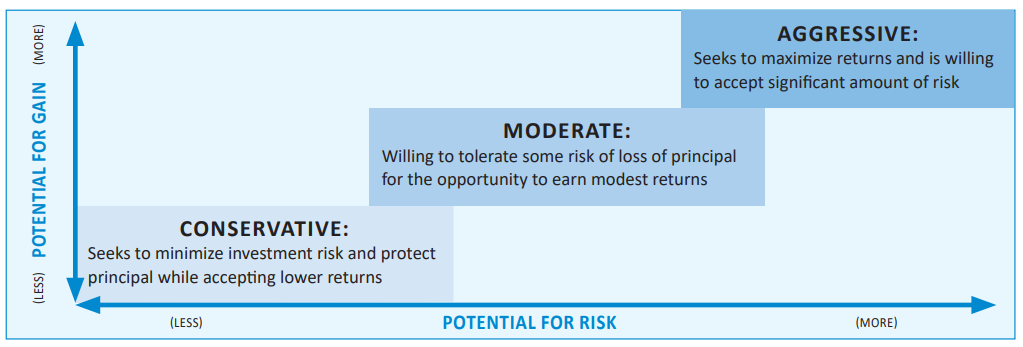
This is a simplified view—there are many custom asset allocations. Investors can apply a unique asset class mix down to the basis point. Nevertheless, after defining an investment purpose, time horizon and risk tolerance, we can see how mission-focused investors can begin to shape their own asset allocation by considering these factors.